
“How long will it actually take before I can surf on my own?”
This is THE question we hear most from beginners booking surf lessons in Taghazout. And it makes total sense—you want to know if you’re investing three days, one week, or an entire month before you can confidently catch waves independently.
As surf instructors who’ve taught over 1000 beginners in Taghazout’s waves, we’re giving you the honest, realistic answer—not the Instagram fantasy version. The truth about learning to surf depends on several factors, but there ARE proven timelines that work for most people.
Here’s exactly how long it takes to learn to surf in Taghazout, what you’ll achieve at each stage, and how to accelerate your progress.
The Short Answer: Realistic Learning Timeline
- To stand up and ride whitewater waves: 1-3 days (2-6 hours of lessons)
- To surf confidently on beginner waves: 5-7 days (10-14 hours of lessons)
- To catch unbroken green waves independently: 2-3 weeks (20-30 hours of lessons + practice)
- To surf intermediate spots competently: 2-3 months (consistent practice)
- To consider yourself a “surfer”: 6-12 months (regular sessions)
Now let’s break down what each stage means and what you can realistically expect.
Table of Contents
Day 1-3: Standing Up and Riding Whitewater
What You’ll Learn
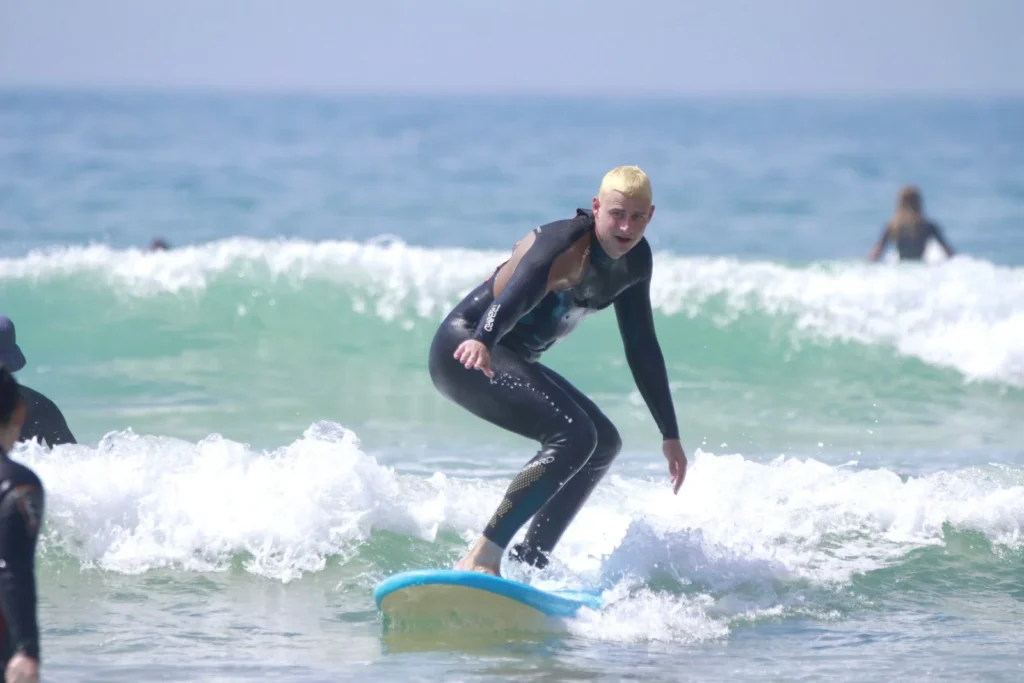
Lesson 1 (Day 1 – 2 hours): Your first surf lesson focuses on fundamentals in the safest possible environment.
- Beach theory: Ocean safety, wave reading basics, equipment introduction
- Pop-up practice: Drilling the movement on sand until muscle memory begins
- First waves: Riding whitewater on your stomach to understand wave power
- Standing attempts: 15-25 attempts to pop up and ride
Realistic Expectations:
- 70% of beginners stand up at least once in their first lesson
- 30% stand up multiple times (5+ successful rides)
- 20% struggle to stand up at all (usually due to timing, not ability)
Sarah, UK (complete beginner): “I managed to stand up twice in my first lesson. Both times I only lasted about 3 seconds before falling, but I was HOOKED. By the end, I understood what I needed to do—my body just needed more practice.”
Lesson 2 (Day 2 – 2 hours): Second lessons show dramatic improvement because your body remembers yesterday’s movements.
- Consistent pop-ups: You’ll stand up on 40-60% of attempts
- Longer rides: 5-10 second rides become normal
- Better positioning: Understanding where to sit in the lineup
- Wave selection: Starting to read which waves work best
Marcus, Germany (athletic build): “Day two was a completely different experience. I stood up on maybe half my waves and actually rode them properly. The instructor said I was progressing faster than average, but I think the daily practice was key.”
Lesson 3 (Day 3 – 2 hours): By day three, most students feel like they’re “actually surfing.”
- High success rate: Standing up on 60-80% of attempts
- Consistent rides: Riding waves all the way to shore
- Basic direction control: Starting to angle left or right
- Ocean confidence: Comfortable paddling and positioning
Milestone Achieved: You can stand up and ride whitewater waves consistently. This is surfing, and you should feel proud!
Key Factors That Speed Up Progress (Days 1-3)
Daily Consecutive Lessons vs. Spread Out
- Daily (recommended): Day 1 → Day 2 → Day 3 = Rapid improvement
- Spread out: Day 1 → Week later Day 2 = Starting almost from scratch each time
Your muscles and brain need repetition QUICKLY while it’s fresh. Consecutive days are 3-4x more effective than weekly lessons.
Group Size Matters
- 2-4 students per instructor: Plenty of individual attention = faster learning
- 5-6 students per instructor: Still good, slight waiting between waves
- 7-8+ students per instructor: Less personal feedback = slower progress
Physical Fitness Impact You don’t need to be an athlete, but these help:
- Upper body strength: Makes paddling easier (less fatigue = more waves)
- Core stability: Improves balance (stand up more consistently)
- Swimming ability: Builds water confidence (less fear = better focus)
Age Considerations
- Under 35: Typically learns pop-up faster due to flexibility and reaction speed
- 35-50: May take an extra day but compensates with better ocean reading
- 50+: Progress is slightly slower but absolutely achievable with patience
Emma, age 52: “I was nervous being the oldest in my group, but by day three I was keeping up with everyone. It just took me a bit longer to get the pop-up smooth.”
Day 5-7: Surfing Independently on Beginner Waves
What You’ll Achieve
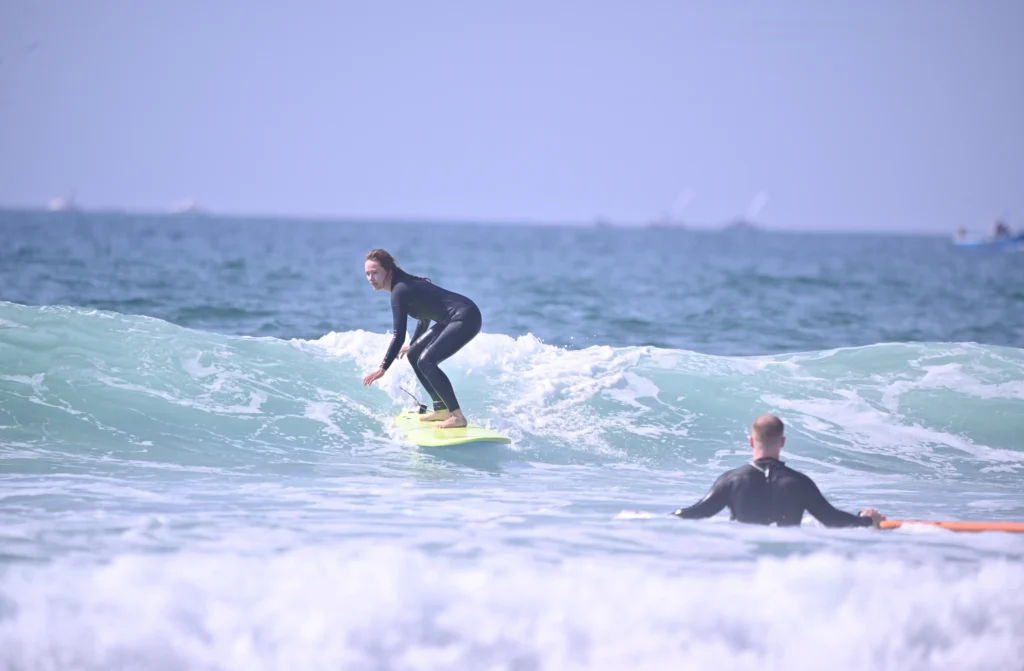
By the end of your first week (5-7 lessons), significant transformation occurs.
Technical Skills:
- Wave selection: You know which waves to paddle for
- Positioning: You sit in the right spot without instructor guidance
- Pop-up: Smooth, automatic movement (muscle memory established)
- Ride quality: 15-30 second rides with basic maneuvering
- Safety awareness: Understand rips, crowds, and ocean dynamics
Mental Shift: You stop thinking about “Can I stand up?” and start thinking about “How can I turn?”
Miguel, Spain (week-long surf camp): “By day seven, the instructor let us surf a session without constant guidance. We knew where to sit, when to paddle, and how to pop up. That’s when I realized I’d actually learned to surf—not mastered it, but learned it.”
Realistic Week-End Abilities:
- Paddle out confidently at beginner beaches (Banana Beach, Panoramas)
- Catch and ride 12-20 waves in a 2-hour session
- Stand up on 70-80% of attempted waves
- Basic turning (angling left or right)
- Recover from wipeouts without panic
Can You Surf Alone After One Week?
Technically: Yes, you have the skills to surf beginner spots Safely: Only at beaches you know, in conditions you’ve practiced Recommended: Continue with instructors for session 2-3x more to build confidence
Week One Common Challenges
Challenge #1: Paddle Fitness Your shoulders, back, and arms will be SORE. This is normal and improves rapidly.
Solution:
- Take rest days (one after every 2-3 surf days)
- Stretch thoroughly after each session
- Stay hydrated (dehydration increases soreness)
Challenge #2: Wave Selection You’re standing up great, but paddling for the wrong waves.
Solution:
- Watch other surfers before your session (5-10 minutes of observation)
- Ask your instructor to explain WHY certain waves work better
- Practice patience (don’t paddle for every wave)
Challenge #3: Fear After a Bad Wipeout One big wipeout can shake confidence, especially if you swallow water or hit the bottom.
Solution:
- Tell your instructor immediately (they’ll help rebuild confidence)
- Take a short break (5 minutes on the beach)
- Start with smaller waves again (rebuild incrementally)
Week 2-3: Catching Unbroken Green Waves
The Intermediate Leap
Weeks 2-3 are where casual surf tourists and committed surfers diverge. This stage requires:
Time commitment: 15-25 additional hours (lessons + practice) Frequency: Surfing 4-5x per week minimum Skill focus: Transitioning from whitewater to green faces
What Changes:
Week 2 Progression:
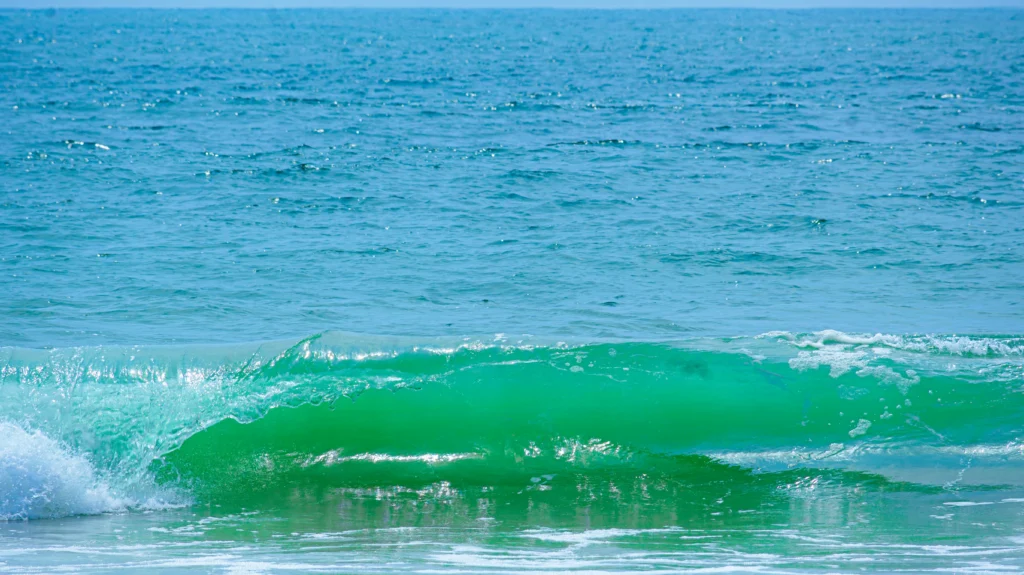
- Unbroken wave attempts: Starting to paddle for green waves before they break
- Timing challenges: This is MUCH harder than whitewater (expect lots of failures)
- Speed requirement: Paddling faster to match wave speed
- Earlier pop-up: Standing up before the wave throws you rather than after
Ava, Australia (2-week surf trip): “Week two humbled me. I thought I was ‘good’ after week one, but trying to catch green waves was completely different. I probably only succeeded on 20% of attempts initially.”
Week 3 Breakthrough:
- Green wave success: Catching 40-60% of green wave attempts
- Ride distance: Significantly longer rides (sometimes 50+ meters)
- Turning ability: Carving basic turns to follow the wave
- Spot variety: Trying different beginner/intermediate spots
Physical Development: By week three, your body has adapted to surfing demands:
- Paddle strength tripled from day one
- Balance and core stability significantly improved
- Ocean awareness becomes intuitive
- Pop-up is completely automatic
Why Most People Stop at Week 1-2
Let’s be honest: Most surf tourists visit Taghazout for 1-2 weeks, leave with whitewater competency, and return home happy.
This is perfectly valid! You learned to surf, had an amazing experience, and can now say “I can surf.”
But if you want to reach true independent surfing ability (catching green waves confidently), you need 3-4 weeks minimum or plan return trips.
2-3 Months: Intermediate Surfer Status
True Independence
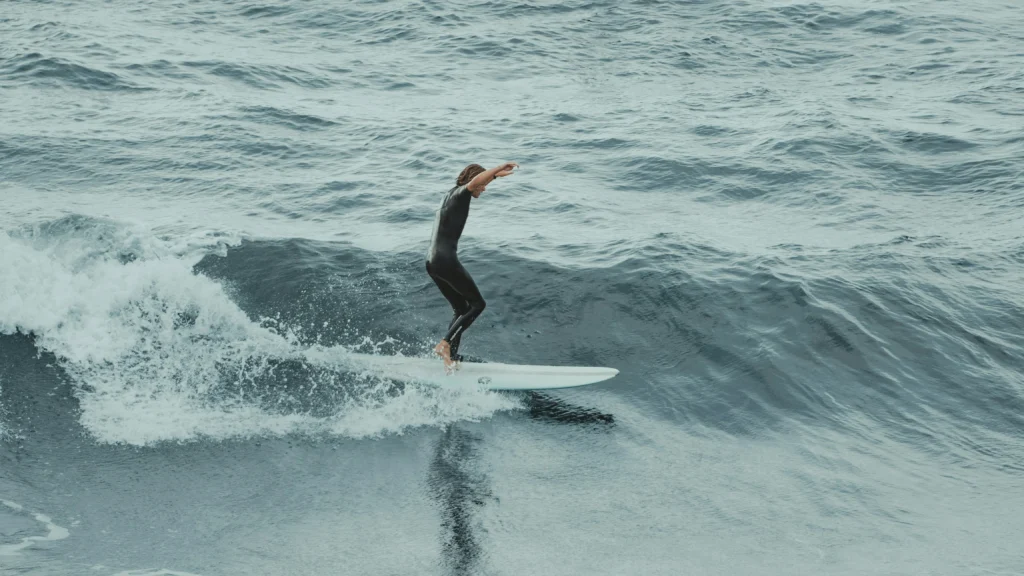
After 2-3 months of consistent surfing (2-3 times per week minimum), you achieve:
Technical Abilities:
- Catch 70-80% of green waves you paddle for
- Execute consistent bottom turns and top turns
- Understand ocean patterns (swell, tide, wind impacts)
- Surf multiple spots with different characteristics
- No longer need instructor guidance
Mental Confidence:
- Check surf reports independently
- Decide which spot to surf based on conditions
- Manage lineups with other surfers respectfully
- Recover from bad sessions mentally
Social Integration: You’re now part of the global surf community. You talk about swells, wind direction, and tide charts naturally.
Liam, Ireland (stayed 3 months in Taghazout): “After three months, I was surfing Anchor Point on smaller days, had local friends I’d surf with regularly, and felt genuinely competent. I wasn’t ripping, but I was surfing.”
Realistic 3-Month Capabilities
- Surf intermediate spots when conditions suit your level
- Catch 15-25 waves in a good 2-hour session
- Execute 3-5 turns on longer waves
- Read and understand surf forecasts
- Rent equipment and surf anywhere (beginner/intermediate spots globally)
What Accelerates Learning Speed
Based on teaching thousands of students, these factors dramatically impact learning speed:
1. Consecutive Daily Practice (Biggest Impact)
Slow Progress Path:
- Surf once per week = 6 months to reach week-1 competency
- Long gaps between sessions = constant restart
Fast Progress Path:
- Surf 5-6 days per week = 2 weeks to reach week-1 competency
- Consecutive days = exponential improvement
Science Reason: Motor skill acquisition requires frequent repetition while neural pathways are forming. Gaps longer than 3-4 days significantly slow learning.
2. Quality Instruction (Game Changer)
Average Instructor:
- Generic feedback (“paddle harder, stand up faster”)
- Large group size (7-8 students)
- Minimal individual attention
Excellent Instructor:
- Specific feedback (“your back foot is too far forward”)
- Small group (4-5 students max)
- Identifies YOUR unique issues
- Video analysis to show exactly what’s happening
Progress Difference: Excellent instruction can accelerate learning by 50-70%.
3. Physical Preparation
Pre-Trip Training (2-4 weeks before):
- Swimming: 2-3x per week, building endurance
- Push-ups: 3 sets of 10-15 daily (builds pop-up strength)
- Planks: 3x 30-second holds (core stability)
- Squats: 3 sets of 15 (leg strength for stance)
Students who arrive physically prepared typically progress 30% faster in first week.
4. Mindset and Attitude
Fixed Mindset: “I’m not athletic, I’ll never get this”
- Quits after struggling day 1-2
- Compares self negatively to others
- Gets frustrated by wipeouts
Growth Mindset: “Every attempt teaches me something”
- Sees failures as learning
- Asks questions constantly
- Celebrates small improvements
Real Impact: Mindset determines whether you quit or persist through the learning curve.
5. Age and Prior Board Sports
Prior Experience Helps:
- Skateboarding: Pop-up timing and balance transfer well (+20% faster)
- Snowboarding: Edge control and reading terrain help (+15% faster)
- Wakeboarding: Water confidence and board control (+25% faster)
No Experience: You’ll still learn, just expect the standard timeline rather than accelerated version.
Age Impact:
- Under 25: Fastest learning (flexibility + fearlessness)
- 25-45: Solid learning speed (experience + fitness balance)
- 45+: Slightly slower but absolutely achievable (wisdom compensates)
6. Taghazout Advantage: Perfect Learning Conditions
Why learning in Taghazout specifically accelerates progress:
Consistent Beginner Waves: Unlike destinations where swells fluctuate wildly, Taghazout offers reliable beginner conditions year-round (especially summer).
Multiple Spot Options: If Banana Beach is too crowded, your instructor takes you to Panoramas, Devils Rock, or another spot—guaranteeing optimal learning conditions daily.
Warm Weather: You’re not fighting cold water or harsh weather. Your focus stays 100% on learning.
Surf Infrastructure: Experienced instructors, quality equipment, and a supportive community surround you.
Different Learning Speeds: Real Examples
Fast Learner (Athletic, Daily Lessons)
Alex, 28, Snowboarder:
- Day 1: Standing up on 8/20 attempts
- Day 3: Standing up on 15/20 attempts, riding waves to shore consistently
- Day 5: Catching green waves occasionally
- Week 2: Catching green waves 60% of the time
- Timeline: Surf independently after 10-12 days
Average Learner (Moderately Fit, Daily Lessons)
Jessica, 35, Yoga Instructor:
- Day 1: Standing up on 3/20 attempts
- Day 3: Standing up on 10/20 attempts
- Day 5: Standing up on 15/20 attempts, consistent whitewater rides
- Week 2: Attempting green waves, catching 30%
- Timeline: Surf independently after 14-18 days
Slower Learner (Less Fit, Weekend Lessons)
David, 48, Office Worker:
- Day 1: Standing up on 1/20 attempts
- Week 1: (2 lessons) Standing up on 5/20 attempts
- Week 3: (6 lessons total) Standing up on 12/20 attempts consistently
- Week 6: Catching whitewater waves independently
- Timeline: Surf independently after 8-12 weeks (weekend lessons only)
Key Insight: David learned to surf—it just took longer because of less frequent lessons and lower initial fitness. But he GOT THERE.
How to Maximize Your Learning in Taghazout
For 1-Week Visitors (Most Common)
Goal: Leave confidently riding whitewater waves
Strategy:
- Book 5-6 consecutive daily lessons (Monday-Saturday)
- Take one rest day mid-week (Wednesday or Thursday)
- Practice afternoons after morning lessons (rent board for 2-3 hours)
- Watch surf videos in evening to visualize techniques
- Stretch and hydrate religiously
Expected Outcome:
- Stand up consistently (70-80% success rate)
- Surf beginner spots independently with confidence
- Understand ocean safety and etiquette
- Ready for your next surf trip anywhere
For 2-Week Visitors (Ideal Timeline)
Goal: Start catching green waves
Strategy:
- Week 1: Daily lessons (6 days)
- Week 2: Lessons every other day (3 days) + solo practice
- Rent equipment and practice what you learned
- Surf different spots to build adaptability
- Consider one private lesson in week 2 for personalized feedback
Expected Outcome:
- Catch green waves 30-50% of the time
- Surf various beginner/intermediate spots
- Independent at beginner beaches
- Solid foundation for continued progress
For 1-Month Visitors (Transformation Timeline)
Goal: Reach true intermediate surfing
Strategy:
- Week 1: Daily lessons (6 days)
- Week 2-4: Lessons 2-3x per week + daily independent practice
- Mix group and private lessons for variety
- Surf different conditions (different tides, spots, swell sizes)
- Film yourself surfing to identify issues
Expected Outcome:
- Confidently catch green waves (60-70% success)
- Surf intermediate spots on appropriate days
- Deep understanding of ocean patterns
- Consider yourself a surfer, not a beginner
Frequently Asked Questions
Q: Can I learn to surf in 3 days? You can learn the basics and ride whitewater waves in 3 days, yes. But “learn to surf” meaning independent green wave surfing takes 2-3 weeks minimum.
Q: Do I need to be fit to learn quickly? Basic fitness helps significantly but isn’t required. You’ll build surf-specific fitness as you learn. Pre-trip conditioning accelerates progress.
Q: Is private or group better for faster learning? Private surf lessons are 30-40% faster for skill development. However, group lessons offer social motivation and are significantly cheaper. For fastest progress: week 1 group + week 2 mix group and private.
Q: How long until I can surf Anchor Point Taghazout? Anchor Point requires intermediate-advanced skills. Realistically, you need 3-6 months of consistent surfing before attempting it safely. Start with beginner spots, progress to intermediate, then Anchor Point when ready.
Q: Can I learn by just renting a board without lessons? Technically possible but incredibly inefficient and potentially dangerous. You’ll develop bad habits, risk injury, and learn 5-10x slower than with proper instruction. Always start with lessons.
Q: What’s the minimum time commitment to surf independently? For true independence (catching green waves, choosing spots yourself, no instructor needed), plan minimum 2-3 weeks of daily surfing or 2-3 months of 2-3x weekly surfing.
The Bottom Line: How Long Does It Really Take?
Here’s your honest answer:
To say “I can surf”: 5-7 days (whitewater wave competency) To surf independently at beginner spots: 2-3 weeks (green wave competency) To feel like a “surfer”: 2-3 months (intermediate progression)
Most visitors to Taghazout come for 1-2 weeks, learn whitewater surfing, have an incredible time, and return home satisfied. This IS learning to surf and counts as a major achievement.
If you want deeper progression, plan extended stays or multiple return trips. The beauty of learning in Taghazout is the consistent conditions—you can pick up exactly where you left off, even months later.
Ready to Start Your Surf Journey?
Now you know the realistic timeline. The question isn’t “How long will it take?” but “When do I start?”
Every expert surfer began exactly where you are: standing on a beach, looking at waves, wondering if they could do it.
The answer is yes. With the right instruction, consistent practice, and perfect learning conditions, you’ll be surfing.
Book your surf lessons in Taghazout today and start your progression.
📧 Email: Booking@taghazoutsurflessons.com
🌐 Book Online: https://taghazoutsurflessons.com/booking/